Sunday, July 12, 2026

Girls in ICT Day at Ndzundza Mabhoko School


We celebrated the Girls in ICT at Ndzundza Mabhoko Sec School on the 29th April 2026. A code club with 40 girls addressed by Amrita Kaur (Pilot) and Lutfyyan Patel Cybersecurity Specialist and AI instructor from Siyafunda Ctc. Thandeka Bhila's song became a brilliant icebreaker 'Im somewhere in the future, and look much better than I look right now,'


There are many inspiring stories about career journeys out there but these girls listened to a 12 year career journey from Amrita, whose journey was back and forth. Her journey illustrated the power of resilience, perseverance and dedication that turns adversity into triumph. From her youngest age she wanted to be a pilot but now she is about to own her aircraft and a pilot school too. Despite her challenges she faced back then in her country, in obtaining her pilot license, she remained focus and clearly assisted by her natural resilience passed on to her at an early age by her parents 
These girls were brave, every pause of the Q&A session, many good questions kept pouring, about the existence of AI, the ethical use and its safety. Their curiosity left us challenged and it also gave us some moment to reflect about having AI literacy initiatives for these young ones. Definitely, it will be our next action.
The session ended with a hands on activities led by Nomusa Keninda, where girls created their coding activities using Scratch programming language on the Raspberry Pi Foundation website Codeclub.org to showcase the Sustainable Development Goals in the community. Brilliant ideas of tackling poverty, saving water, quality education and many more that demonstrated the power of girls in the rural villages to sustain their lives. 
Their certificate ceremony created a long lasting memory of the day. They celebrated their resilience to education and committed to their studies to become role models to other girls in their community. 

Wednesday, March 25, 2026

The Power of AI Integration in Content Development

 The Power of AI Integration in Content Development

Dr Motene and Mr Lara 
leading the workshop

The first quarter of 2026 is incomparable. Others were known to be involved in the year-end administrative dust. This year's first quarter was unique for almost 300 teachers in the 8 pilot smart schools of the Ubuhlebuzile eLearning Project in Mpumalanga province, as well as our provincial and district subject advisors. It was more than just getting through the last financial year; it was a wonderful example of digital transformation. Thanks to Dr Motene and Mr Lara of the Department of Basic Education for making this transition possible. 

The two expert trainers, together with my eLearning colleagues, refused to let technical glitches or tight schedules dampen the mission to empower teachers. We wanted to turn the series of these workshops into a landmark moment for South African education and for teachers in particular.


Managing this series of workshops with over 300 teachers and subject advisors is no small feat. Mr Lara and Dr Motene knew that a "one-size-fits-all" would not be effective. Instead, they designed a high-energy, hands-on environment where theory and practice seamlessly integrate. 

The core of the training focused on DBECloud Content Development and Artificial Intellingence on the Moodle LMS. I watched with envy when Lara transformed what I perceived as a rigid learning management system into a vibrant, interactive Moodle classroom. By introducing the H5P tools in Moodle, Lara showed us how to create interactive videos and branching scenarios that will leave learners captivated in our classrooms. The "aha" moment occurred when he demonstrated how to connect AI with LMS. I followed him as he showcased the use of ChatGPT, Gemini and the popular NotebookLM to generate structured lesson plans and quiz banks that could be imported directly into Moodle with a few clicks and a few seconds.


While the technical excitement piqued our interest, Motene stepped in to provide the essential ethical use of AI in education. His presentation on the Ethical Use of AI was the workshop's grounding force. I listened to him, as he challenged all of us to think beyond "cheating" and focus on "empowerment." The discussion on data privacy, the importance of human touch in assessment and of ensuring that AI serves to narrow the digital divide rather than widening it were thought-provoking insights in the room.

Jerry Masilela assisting teachers 


Despite the challenges encountered during the workshops, including moments of disappointment, load-reduction interruptions, connectivity drops due to hard rain, and the "tech-phobia" of those overwhelmed by the new digital tools, the sessions proceeded smoothly. I admired and respected how the two experts navigated the bad days with the same grace they handled the good ones. When others felt lost, my colleagues and I were there to encourage them to regain their confidence and continue their progress.

Honestly, collaborating with Dr Motene and Mr Lara in this series of training workshops was a lesson in resilience and a genuine spirit of collaboration. They didn't just teach the tools; they also modelled the mindset required to thrive in a digital world. Teachers, too, didn't just leave with certificates, but they are now digital architects of their classrooms. 


As for my colleagues and me in eLearning in Mpumalanga, the baton is in our hands, and dropping it IS NOT A CHOICE.

 Written and published by Nomusa Keninda 


Tuesday, January 6, 2026

Girls are somewhere in the future #DigiGirlz


"I'm somewhere in the future, and I look better than I look right now." Thandiwe Mbila  from Mkhephuli Secondary School came up with this phrase, and now it has become part of our workshops to motivate learners to picture their future, especially their workplace. It is a gem rap followed by a snapping of fingers and footsteps. I really loved it, especially yesterday with the girls in a DigiGirlz workshop at Morelig Secondary School.

The girls were joined by Sheena Satikge-Sibisi  virtually to share some of her experience during her career journeys. As a young star inspired by how townships were designed in South Africa it motivated her to study town planning.

She shared how she navigated high school troubles using confidence and a positive attitude to show up where no one could imagine. She delivered a powerful lesson to these young stars.

The DigiGirlz workshop is one of the intensive sessions where girls are taught various 21st-century skills, including career guides to STEM. We had a design thinking session where they had to identify problems in various newspaper articles, develop problem statements, brainstorm and design prototype solutions. After this exercise, the girls presented their work to the group for positive criticism and improvement.

Another session involved a coding and robotics lesson where girls were introduced to various platforms to learn coding skills. This time, we used one of the Raspberry Pi Foundation  Scratch projects for beginners, and the girls were excited to get this opportunity to learn the skill.

I take this opportunity to thank Ms. Malevu of Morelig school who was on leave yesterday but made this event happened at her school. My colleagues Duduzile, Glenda and Sheena Satikge-Sibisi for supporting the workshop. I appreciate the support from the Nkangala TVET College  for sponsoring some goodies for the girls.

Saturday, December 27, 2025

STEM Spirit Ignited at Gogo Makhotha’s Home

The love of STEM burned brightly at Gogo Makhotha’s home on 26 December event hosted by the Elevate Club in partnership with the Mpumalanga ICT Club as more than 50 children from Grade RR to recent matriculants gathered for a day of learning, innovation and celebration. Despite heavy rains earlier that morning, clear skies welcomed the kids as they arrived eagerly at 10:00. For many of them, the day had special meaning.
“Some parents told me their children were saying, ‘Today is the best of the best day, please take me to Gogo Makhotha’s home!’” Phumla Nkonde, the chairperson and founding member of the club shared.
The event opened with a first-of-its-kind 5km fun run from the nearby village of Mkhumulo—humorously named “remove your jacket.” Excitement was high as children lined up on the gravel road, determined to sprint their way to the finish line at Gogo Makhotha’s gate.
Bandile Sukazi, representing the family’s third generation, secured the first gold medal with an impressive performance. In total, five gold medals and ten silver medals were awarded, with two girls among the silver winners. All other participants proudly received bronze medals for completing the race.
The programme continued with an inspiring address from Nomzamo Makhotha, a drone pilot and member of the family’s first generation of grandchildren. She shared her journey in aviation and emphasised the critical role of mathematics in her field.
“I am not just flying a drone,” she said. “I passed mathematics in high school, and that opened the path for me to qualify as a drone pilot and a Software Engineer. There is a lot of maths and problem-solving involved in flying a drone.”
When she asked the children if they would like to fly one, a loud and unanimous “yes!” echoed across the gathering—giving her the perfect opportunity to reinforce the importance of aiming high in mathematics.
Under the theme “Robot Design Thinking,” groups of children then brainstormed solutions to challenges facing their community of Maserijini. While many groups impressed, it was the team calling themselves Manarator that stood out. Their project tackled water scarcity, presenting a clear problem statement, identifying key stakeholders, and outlining their role in promoting water-saving awareness. They also proposed practical techniques for monitoring water levels and detecting leaks at household level. The judges; Siyabonga, Nomusa and Nomzamo were impressed about the presentations.
The final activity of the day brought colour and excitement as Siyabonga Nkonde and Nomzamo led a session on making paper planes and cranes using brightly coloured papers—matching the Elevate Club’s logo. Soon, the field was filled with soaring paper planes, some gliding above the stretch tent as children experimented with their designs.
The event ended with cheers and laughter, with Gogo Makhotha and her neighbours proudly celebrating the children’s achievements. At one point, she joked enthusiastically, “Next year, all the grannies must join the fun run—and I will lead them!”
(Nombulelo Zulu (Club Treasure), Erica Zulu(Member), Phumla Nkonde ( Club Chairperson) and Nomusa Keninda ( Founder of the Mpumalanga ICT Club and Mentor to the club)

Story enhanced by AI.

Tuesday, November 11, 2025

Beyond the Classroom, We shape the Future

(Duduzile, Nomusa, Lorancia and Joyce)

Inside the club house of Middelburg Primary School, a third gathering of a vibrant community of practice made up of after-school programme leaders from across the Mpumalanga province took place. These were not just meetings—they were moments of alignment, of vision, of building something bigger than any one organisation could achieve alone.

At the heart of the session was the newly released Quality Standards for After-School Programmes Toolkit. Designed to elevate the impact of after-school initiatives, the toolkit anchored four foundational pillars of the quality standards for after-school programmes.
1. Quality Programme Design: Ensuring that every activity is intentional, inclusive, and aligned with developmental outcomes.

2. Environment, Health, and Wellness: Creating safe, nurturing spaces that support learners’ physical and emotional wellbeing.

3. Partnerships: Strengthening collaboration between schools, communities, and stakeholders to collaborate.

4. Human Resources and Relations: Investing in the people who make the programmes thrive—through training, support, and recognition.

As the rain gently poured on the school's sports ground, facilitators from The Learning Trust guided us through reflective exercises, case studies, and practical strategies that we all contributed in group activities. Laughter mingled with deep discussions as we exchange ideas and make commitments 
(After-school programme leaders with Learning Trust facilitators)

This was more than a training, it was a reaffirmation that in every corner of South Africa, after-school programmes are not just filling time—they are shaping futures of this country.
(Sarai demonstrating an AI robot for foundation phase)

Saturday, September 20, 2025

DigiGirlz Coding Bootcamp 2025 for eMalahleni 2

 51 grade 7-9 girls participated in a DigiGirlz workshop at eMalahleni 2 circuit. Our talk was all about future careers, positive personal branding and online safety.

We also introduced the girls to Scratch coding using the Raspberry Pi Foundation Scratch activity called "Catch a bus"  
Our popular rap song composed by Thandiwe Mbila came alive again here "I am somewhere in the future and I look better than I look right now." Yes we hope that the girls will push through to their careers, focusing on their dreams. 

The #DigiGirlz Initiative was launched in 2018 and we managed to share the 7th anniversary of the DigiGirlz Initiative with the girls. 

We prayed that the divine mercy of the Almighty protects them as they grow up to achieve their future dreams.

Friday, August 29, 2025

DigiGirlz Coding Bootcamp in the Nkangala District

https://www.backabuddy.co.za/campaign/digigirlz-coding-bootcamp
We are starting at Sbongindawo Primary School with the eMalahleni 2 Ogies schools.

Sunday, August 24, 2025

Sbongindawo Code Club Officially Launched

What an interesting day I had with grade 4-7 learners who were in the computer lab for the first time in their lives, officially launching their Code by hosting Scratch Day. It happened on August 20, 2025. Sbongindawo Primary School.

We discussed how computers are used in various sectors and what tools or methods were used before. 

I observed their nervousness as they touched the mouse to point out their sprites, scrolled their screens, and dragged and dropped their coding script palettes across the Scratch interface. 

It was difficult, but they were determined to complete their project. It is a rewarding job to teach coding skills to the young ones. You experience a journey with emotional intelligence, patience, and resilience. Once you see their confidence growing, that moment also becomes yours.

We completed our project with big smiles that conveyed the message, "We can do this."

I take this opportunity to thank the teachers who teamed up to open this opportunity for our kids, especially from this mining farm village, and appreciate the mining company Puma Energy which donated the 40 brand-new desktops and the computer lab to this school.(We are protecting the school name for the safety of their resources.)
#computerscienceeducation #coding #robotics Scratch Raspberry Pi Foundation Rujeko Moyo

Monday, July 14, 2025

I am a STEM Advocate - My short reflection

I have been an active STEM advocate for more than 30 years. I started teaching in 1994 at Ilanga Secondary School. The school used to receive after-school support from Eskom engineers, who taught Mathematics and Science in the afternoons, weekends and holidays. The school was well-known for quality performance when it comes to STEM subjects during those years. This venture motivated me to look back to those years when I started the DigiGirlz Initiative. I will forever be a STEM advocate.

Today, I’m joining many STEM or STEAM advocates who are disappointed by the announcement of the Department of Basic Education, a call to make coding and robotics no longer mandatory. Bad as it looks, I draw some strength from my research, “Grade 8 and 9 girls’ perceptions of coding and robotics in a DigiGirlz workshop in the Nkangala District.”. The study found that many developed countries integrated coding and robotics in other subjects like mathematics, science and computer science and not as a standalone subject like what South Africa aimed to do. Countries in Europe use robotics to inspire kids to follow STEM fields as they grow; no wonder these countries have strong engineering skills. As a STEM advocate, I am implementing similar strategies and will continue to incorporate coding and robotics into STEM education to encourage children, particularly girls, to pursue careers in STEM fields, as gender segregation in these areas remains persistent.

Along my journey, I met professionals, supporters, organisations and those who sponsor my name in various platforms, I learnt from the best. I remember my first supervisor who tend down my first research topic and directed me to the DigiGirlz Initiative for my Master's degree dissertation, Dr Jacqueline Batchelor. "I hope you are still proud of me".

Over the past few years, I joined Prof. Jean Greyling, at the Nelson Mandela University and became an unplugged coding ambassador. I saw and tested the possibility of implementing coding and robotics concepts with a low cost budget and resources. It remains feasible to continue our efforts as we incorporate stronger literacy and numeracy into foundational learning throughout the entire country. 

Thursday, February 6, 2025

Vuma Primary School excited about coding and robotics

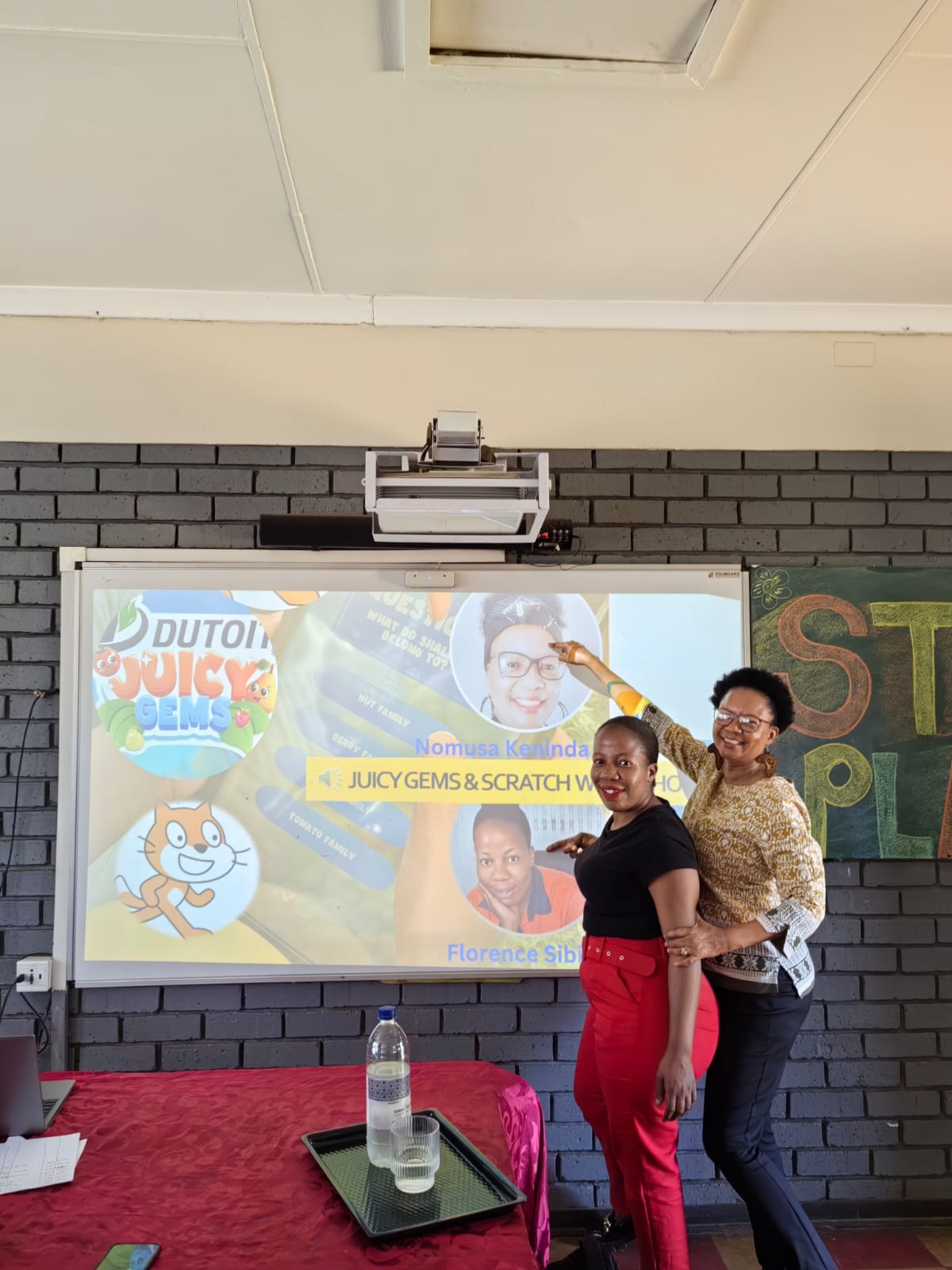
Vuma Primary School kids had fun and excitement to learn more about coding and robotics subject. On the 24th January 2025, Nomusa Keninda, a coding and robotics instructor joined by Florence Sibiya and Ms Veronica Mahlangu conducted a workshop with the grade 4 class using Juicy Gems and Scratch App.

 
The session started with learners turning a phrase into a song "I'm somewhere in the future and I look much better than I look right now" this was a phrase composed by Thandiwe at Emthunzini Primary School when we were launching their science club.
We significantly use this phrase at Vuma Primary School for the grade 4s to picture their future that will definitely look better than right now. “Our workshop can be summarised in one word "JuicyGemScratch" sounds fantastic as I say it loud”. Keninda said.
The workshop introduced the kids to coding and robotics using a Juicy Gems App developed by Dutoit Agri, a leading producer of fruits and vegetables farm in South Africa. Juicy Gems is a mobile game app that teaches learners how to code through play. In the game, learners pause for a question about farming. A cool game indeed.
A well-known coding app Scratch was also introduced to these learners, where they learn about the Scratch Editor Interface and they were assigned to edit the Costumes of their own preferred “Sprites”. Sprites are characters in Scratch. This activity also assessed their level of creativity and art competencies. “Children love playing with colours and creating their own stories” Mashinini confirmed.
Keninda promised that this workshop was not a once off event with Vuma Primary, they planted a seed that would be nurtured by teachers led by Ms Veronica Mahlangu and the two Tangible Africa Coding Ambassadors, Duduzile Mashinini and Bayanda Zulu.

Friday, January 10, 2025

Elevate Club Launched at Edenvale Village

(95 years old Gogo Makhotha's village)

Gogo Makhotha’s home can be described as a warm vibrant space for joy and connection. A haven of creativity that makes every corner to whisper “Free yourself, you are at Gogo Makhotha’s home”

Assisted by parents who accompanied their kids to their favourite spot on the 26th December 2024. This gesture suggested that the wait was worth every day and the present moment blended by the sunny day was perfect for the event.


“Today we are here to celebrate the 3rd anniversary of this event and to officially launch the Elevate Club, your club is here at Edenvale village”  stated the Chairperson of the Club,  Phumla Nkonde. She was talking to the community youngsters and their parents who gathered in the tent for the event. On behalf of the club executives, Phumele Jele,  serving as a Secretary and Nombulelo Zulu, a Treasurer, she invited everyone to support the club.

(Phumla- left and Phumele- Right)


The day was filled with three main activities: team  building activities, creative coding for the little ones and coding tournament using the Juicy Gems App created by Dutoit Agri in collaboration with Tangible Africa.

When the event finally started, everyone was ready to make his or her team proud in all the team building activities planned for the day.  It was confirmed by the their team names that they were ready to compete. Every child was afforded an opportunity to express his or her level of creativity including the little ones, who never minded the rules of the activities but were determined to finished the tasks given.


I once again observed their delight, curiosity as they handle the tablets.  You can tell from their tiny fingers all over the screens as they waited for instructions, indicating that this was their first time using tablets. Mostly completed the game with average to high scores of between 46 to 120. It was challenging to pick the correct answers from the Juicy Gems App question sections because the Dutoit Agri was about fruits farming and they were from livestock farming background. It was going to be easy to answer questions about Gogo Makhotha’s cattles or the late Magwazas’ sheeps. Magwaza was name given to the first farmer in this village and the farm is now owned by his son called Maniki.


The Mpumalanga ICT Club was instrumental in ensuring that this village establish it's own coding club and we acknowledged the support: firstly from Vuma Primary School in eMalahleni for the tablets, Nomzamo Makhotha wh managed to address the curiosity of these youngsters about drone technology and Nomusa Keninda for mentoring and coaching the Elevate Club executive members who are also Tangible Africa's interns and coding ambassadors. Lastly, we salute Gogo Makhotha for making her home, a source of  growth, hope and inspiration to elevate the community of Maserijini village.